
[BLOG] "코리안. Korean."
- Jina Nam
- Feb 12, 2024
- 5 min read






코리안
한 교수님의 강의를 들은 기억이 있다. 영어로는 “Korean”하면 우리에 대한 많은 것을 설명한다. 한국어 (Korean language), 한국 음식 (Korean food), 남한 사람 (South Korean), 북한 사람 (North Korean), 해외 있는 한국인 (Overseas Korean). 그래서 음악이든 화장품이든 음식이든 편하게 “K-”를 앞에 붙일수 있는 면도 있다. 그런데 막상 한국어로 이 많은 것들은 “한국의 일부”로 한 단어로만 가지고 표현할수가 없다.
해외에서 태어나거나, 살고 있는 또는 살다가 온 한국인을 통칭할때 어떤 단어를 써야 하나?
해외 또는 재외, 교포 또는 동포. 어떤 표현이 맞나? 그리고 이 표현이 왜 중요한가?
“해외”는 주로 섬나라가 사용하는 용어, “바다를 건너”라는 뜻이 있는 반면, “재외”는 단지 외국에 있다, “국외”는 나라밖이라는 표현을 가지고 있다.
“교포”는 다른 나라에 살고 있는 사람, 좀 더 구체적으로 말하면 현지에 정착하여 “국민으로서 법적 지위를 가진 사람”을 뜻한다. “교”는 더부살이한다, “남의 집에 얹혀산다”라는 뜻도 포함이 되어 있다고 한다.
“동포”는 같을 동, 자궁 포, “한 부모에게서 태어난 형제자매, 나아가 같은 민족 사람을 다정하게 이르는 말”이라는 뜻이다. 어디에 살든, 어느 국적을 가지고 있는지와는 상관없이 큰 범위로 ‘같은 민족’이라는 말이다.(1)
섬나라라는 인식에서 벗어나 세계에 뚜렷한 위치를 지키고 있는 국가로서의 사고전환을 가르키는 “재외”라는 표현. 그리고 멀리 있는 사람 보다는 멀리 있어도 우리의 일부라는 표현을 쓰며 한국인을 포괄적으로 보는 “동포”라는 단어. 그래서 현재 “재외동포청”이라고 하는 것이다.
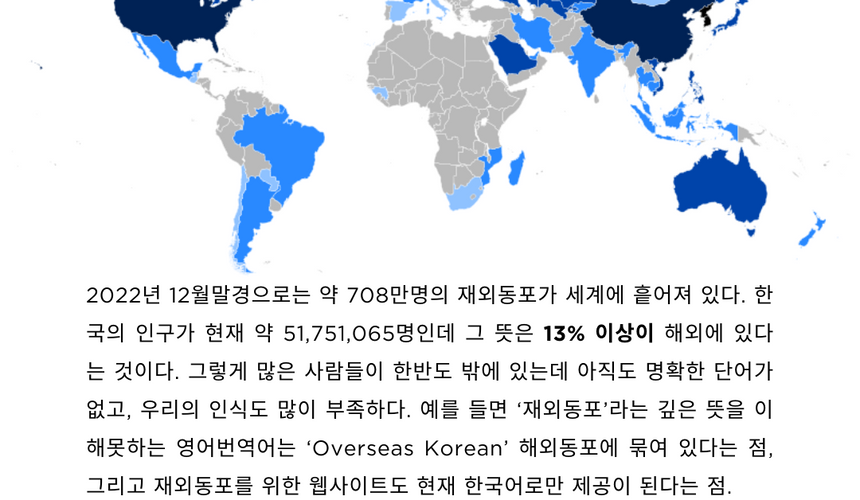
2022년 12월말경으로는 약 708만명의 재외동포가 세계에 흩어져 있다. 한국의 인구가 현재 약 51,751,065명인데 그 뜻은 13% 이상이 해외에 있다는 것이다. 그렇게 많은 사람들이 한반도 밖에 있는데 아직도 명확한 단어가 없고, 우리의 인식도 많이 부족하다. 예를 들면 ‘재외동포’라는 깊은 뜻을 이해못하는 영어번역어는 ‘Overseas Korean’ 해외동포에 묶여 있다는 점, 그리고 재외동포를 위한 웹사이트도 현재 한국어로만 제공이 된다는 점.(2)
러시아로 간 한국인들, 일본으로 간 한국인들, 중국으로 간 한국인들, 미국으로 간 한국인들, 유럽으로 간 한국인들. 당시 한국을 떠나야했던 사유는 당시 한국의 상황과 역사를 기록하는 시점이고, 그 사람들이 기억하고 있는 한국은 마치 타임캡슐과 같이 그 당시 한국인, 한국의 모습을 간직하며 각각 한국의 역사를 한반도 외에서 이어가고 있다.
오늘날 국내로 귀국하는 동포들도 많고, 외국에서 활동하는 한국인들도 많아지고 있다. 그래서 이제는 다양한 경험과 배경을 가지고 있는 한국인들의 비중이 커지고 있다. 국내의 다문화가정도 포함이다. 지금까지 우리가 생각해온 “한 민족”을 다시한번 생각해볼 필요가 있다.
“재외동포”라는 하나의 표현이 한국의 변화하는 인식을 대표적으로 상징하듯이, 단어 하나에 참 많은 의미를 가지고 있다. “Korean”이라는 표현과 달리 “한국의 일부”를 표현하기 위한, 한국의 정체성을 명확하게 하기 위한 논의가 필요하다.
“Korean”
I remember attending a lecture once, given by a Korean professor who also grew up abroad. He explained how in English, anything related to Korea could be described in one word: “Korean”. The Korean language, Korean food, Korean people (South Korean, North Korean, Overseas Korean, Korean-American, etc.). All we have to do now is put “K-” in front of anything, music or food, and conveniently recognize it to be of Korea. But strangely in the Korean language itself, it was difficult to find such a word that describes anything “of Korea”.
What do we call people who were born abroad, live in other countries or have returned after having done so? In English, we can refer to them as “Overseas Koreans” generally, or “of Korean origin” because of the word “Korean” but if the Korean language does not provide a single word to refer to “of Korean roots” it becomes complicated. There’s 해외(Overseas) or 재외(Abroad), 교포(Gyopo) or 동포(Dongpo). Which term is appropriate or correct, and does the difference and our selection of words matter?
해외(Overseas) as the English word describes, has usually been used by ‘island nations’ as we have to refer to things ‘over the seas’. On the other hand, 재외(abroad) simply refers to things that are out of the country, like 국외(out of the country).
교포(Gyopo) refers to a Korean who lives in another country, specifically one who has obtained a legal citizenship and position within that host country. The “교(Gyo)” comes with a meaning of living with someone, live “on top of” meaning to live as a burden to the host.
동포(Dongpo) is supposed to be a more affectionate term, referring to brothers and sisters with the same parents, people of the same line and ethnicity. Wherever they may be living, with whatever nationality they may have, in the broadest sense they are ‘our people’.(1)
The specific term used is Overseas Koreans in English, and 재외동포 in Korean. Analyzing the Korean term, we can say that the ‘island mentality’ has been replaced with a more confident country that simply refers to everything outside of its borders as overseas. They are not isolated but a part of the global world, and so everything is not far over the waters but simply out of the country. The people who are out of the country are also not far away people, but they are our brothers and sisters of the same root and same family. They are 재외동포, and the Ministry is thusly called in Korean.
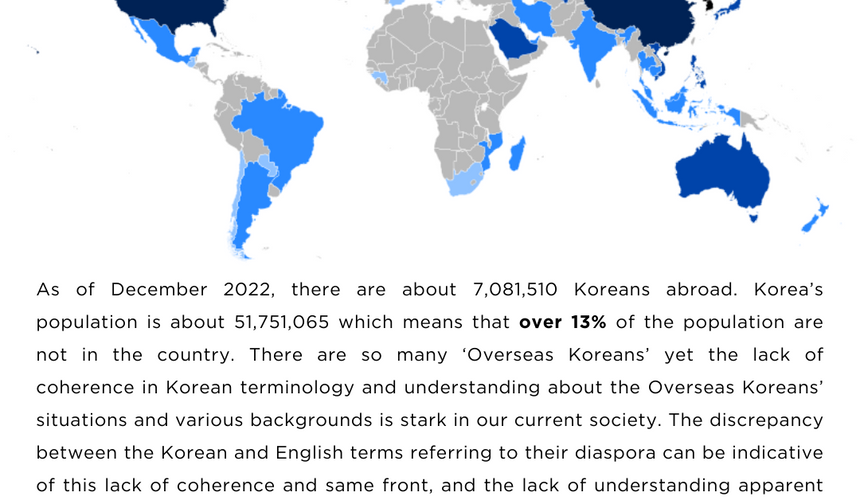
As of December 2022, there are about 7,081,510 Koreans abroad. Korea’s population is about 51,751,065 which means that over 13% of the population are not in the country. There are so many ‘Overseas Koreans’ yet the lack of coherence in Korean terminology and understanding about the Overseas Koreans’ situations and various backgrounds is stark in our current society. The discrepancy between the Korean and English terms referring to their diaspora can be indicative of this lack of coherence and same front, and the lack of understanding apparent in the fact that many resources supposedly for Overseas Koreans, including the Ministry’s main website, are only available in the Korean language.(2)
There are Koreans who have gone to Russia, to Japan, to China, to the US, and to Europe. All of these people are witnesses and testimonies to the historical time period that Korea was going through at the time of their emigration, whatever their reasons for leaving may have been. They are like time capsules, records of what Korea and Koreans were like at that time, and they continue to write and expand Korea’s history outside of the peninsula in their own ways.
Today, there are many Overseas Koreans who are returning to their homeland, and many Koreans who are leaving to make an impact abroad. The Korean population is perhaps no longer so ‘homogeneous’ in terms of their mainland experience, as more and more people have a variety of different experiences and backgrounds that don’t tie them to the mainland alone. This includes multicultural families within the borders too. There is a need for us to re-evaluate and discuss what it means to be a homogeneous nation or “한 민족”.
Just as a single word, “재외동포” (overseas Koreans/ Koreans abroad), is telling of Korea’s changes in perspective, there are huge implications and consequences in words. We need to discuss what it means to be “Korean”, not just who is included in this category, but in this day and age, in this current global society, what does it mean to be “Korea” and of Korea?
![[먼데이타임스] 문화유산복지재단 남지은 연구원](https://static.wixstatic.com/media/20b402_1f4d52b5045140f1aa7cf78ed0d1d508~mv2.png/v1/fill/w_769,h_791,al_c,q_90,enc_avif,quality_auto/20b402_1f4d52b5045140f1aa7cf78ed0d1d508~mv2.png)
![[JTV뉴스] 조국혁신당 국민오디션 ⑥ 남지은 문화유산회복재단 연구원](https://static.wixstatic.com/media/20b402_376015da797e484a9b0107ba4dd5a4b4~mv2.png/v1/fill/w_768,h_713,al_c,q_90,enc_avif,quality_auto/20b402_376015da797e484a9b0107ba4dd5a4b4~mv2.png)
![[KBS대전] 숨겨진 문화유산을 회복하는 사람들 – 문화유산회복재단 / KBS대전 20240208 방송](https://static.wixstatic.com/media/20b402_3d45b399df9d4c32bd8ef11dca47de21~mv2.png/v1/fill/w_753,h_881,al_c,q_90,enc_avif,quality_auto/20b402_3d45b399df9d4c32bd8ef11dca47de21~mv2.png)